Home · Guides · Invoice examples
Real examples, every part labelled
What a good invoice actually looks like
Most people writing their first invoice have never really looked at one. Here are three real examples — a designer, a consultant, and a photographer — so you can see the shape of a clean, professional invoice before you make your own. Each was built in about a minute, in a browser, with nothing uploaded.
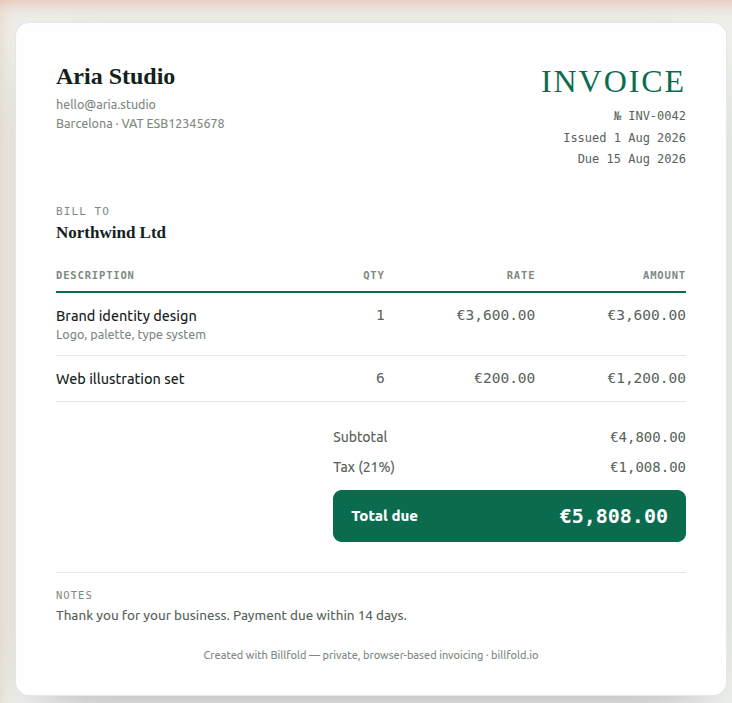
Freelance designer · EUR
A design studio invoice
- Line items with sub-notes — "Brand identity design" carries a small "Logo, palette, type system" note so the client knows what they're paying for.
- VAT shown separately — the 21% is a distinct line, not baked silently into the total, which is what most tax authorities expect.
- One clear total — the amount due is the loudest thing on the page.
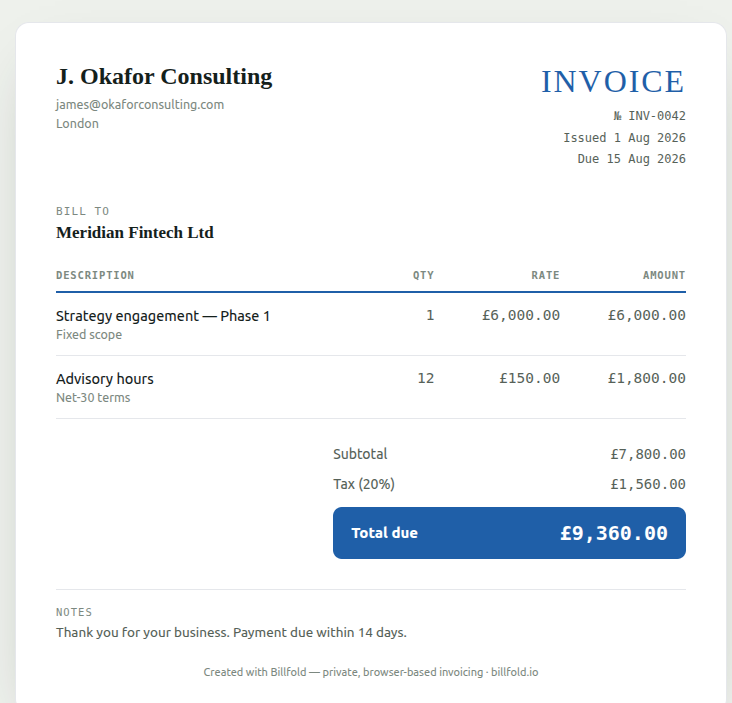
Developer / consultant · GBP
A consulting invoice
- Mixed billing — a fixed-scope phase and hourly advisory sit on the same invoice, each with its own quantity and rate.
- Terms stated — "Net-30" tells the client exactly when payment is due, which is the single biggest lever on getting paid on time.
- Sequential number — INV-0042 is part of an unbroken run, which is what an accountant (or an audit) wants to see.
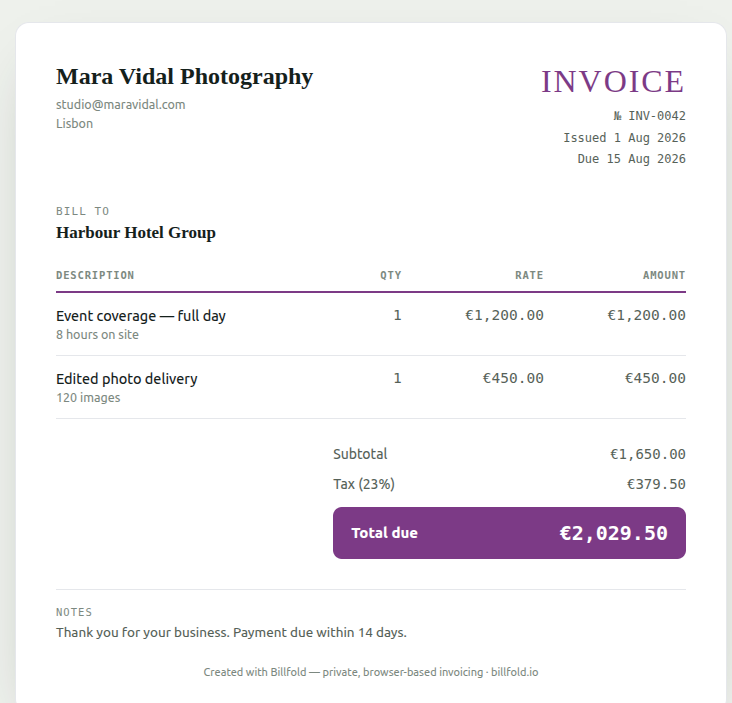
Photographer · EUR
A photography invoice
- Deliverables as line items — "Event coverage" and "Edited photo delivery" are separated so scope is unambiguous.
- Quantities that mean something — "120 images" in the sub-note sets a clear expectation.
- Issue and due dates — both are present, so there's no argument about when the clock started.
The anatomy of an invoice
Strip away the styling and every invoice answers five questions. If yours does all five clearly, it's a good invoice.
- Who
- Your name and details, and the client's — so it's unambiguous who's billing whom.
- What
- Line items: a description, quantity, and rate for each thing you did.
- When
- An issue date, a due date, and a unique invoice number.
- How much
- A subtotal, any tax or discount shown separately, and one clear total.
- How to pay
- Payment terms — and, ideally, a link or button so the client can pay in one tap.
What's legally required on top of this varies by country — VAT numbers, tax IDs, and specific wording. We keep a cited breakdown in the invoice requirements by country guide.
Make one that looks like this.
Open Billfold and you're editing an invoice like the ones above in seconds — your logo, your currency, a clean PDF. In your browser, no account, nothing uploaded.
Create an invoice →Common questions
What should an invoice look like?
Clean and unambiguous. At the top, who is billing whom. In the middle, line items with a description, quantity, and rate. At the bottom, a subtotal, any tax shown separately, and one clear total, plus payment terms. The examples above are all built this way.
What has to be on an invoice legally?
It depends on your country and whether you're registered for VAT/GST. The universal core is both parties' details, a unique number, dates, itemised charges, and the total. For the exact statutory fields per country, see our cited requirements by country guide.
How do I make an invoice like these?
Open Billfold, fill in your business, your client, and your line items, and it renders live as you type. Export a clean PDF, or share a view-only link. It runs entirely in your browser — no account, and nothing is uploaded.
What's the difference between an invoice and a receipt?
An invoice requests payment before it's made; a receipt confirms payment after. They're different documents for different moments — we cover the distinction in invoice vs receipt vs quote.